The food truck industry is booming, offering entrepreneurs a flexible and exciting avenue to share their culinary creations with the world. But with this freedom comes a need for reliable power – to run refrigerators, cooking equipment, lighting, and point-of-sale systems. Traditional generators, while common, are noisy, polluting, and require constant refueling. Enter solar panels: a clean, sustainable, and increasingly cost-effective alternative that can revolutionize your food truck business.
This article provides a comprehensive guide to understanding and implementing solar panels for your food truck. We'll delve into the benefits, the components needed, installation considerations, potential challenges, and everything else you need to know to harness the sun's energy and power your mobile kitchen.
Powering Your Culinary Dreams: A Comprehensive Guide to Solar Panels for Food Trucks
1. Why Go Solar? The Benefits of Solar Panels for Food Trucks
Investing in solar panels for your food truck offers a multitude of advantages that extend beyond simply reducing your carbon footprint:
- Reduced Operating Costs: This is arguably the most significant benefit. Solar power eliminates the need for expensive gasoline or propane to run a generator. Over time, the savings on fuel alone can easily offset the initial investment in a solar system.
- Environmental Friendliness: By switching to solar power, you're significantly reducing your reliance on fossil fuels and minimizing your carbon emissions. This eco-friendly approach not only helps the environment but also appeals to environmentally conscious customers.
- Quieter Operation: Generators are notoriously noisy, creating a disruptive and unpleasant environment for both your staff and customers. Solar panels operate silently, allowing you to create a more inviting and enjoyable atmosphere.
- Increased Independence and Mobility: With solar power, you're not tethered to a generator or electrical hookups. This allows you to operate in more remote locations, participate in events without access to power, and generally enjoy greater flexibility in where you set up shop.
- Enhanced Brand Image: Promoting your food truck as an eco-friendly business can attract a wider customer base and enhance your brand image. Solar panels are a visible symbol of your commitment to sustainability, which can resonate with environmentally aware consumers.
- Potential Tax Incentives and Rebates: Many government programs offer tax credits and rebates for installing solar energy systems. These incentives can significantly reduce the upfront cost of your solar panel investment.
- Reduced Maintenance: Solar panels require minimal maintenance compared to generators. Regular cleaning and occasional inspections are typically all that's needed.
- Long Lifespan: High-quality solar panels are designed to last for 25 years or more, providing a reliable and long-term source of power for your food truck.
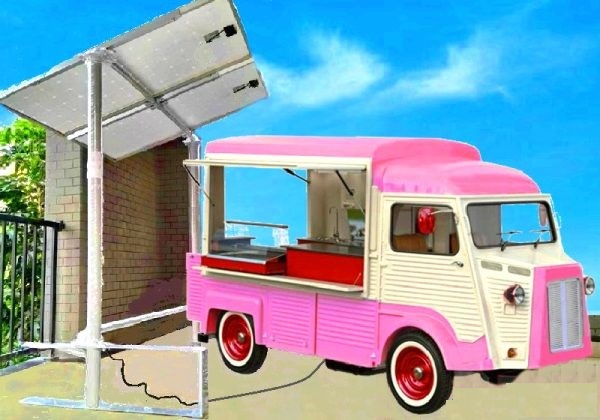
2. Understanding the Components of a Food Truck Solar System

A complete solar panel system for your food truck comprises several key components:
- Solar Panels: These are the heart of the system, converting sunlight into direct current (DC) electricity. They are rated in watts (W) and come in various sizes and efficiencies.
- Charge Controller: This device regulates the flow of electricity from the solar panels to the batteries, preventing overcharging and extending battery life. It also optimizes the charging process for different battery types.
- Batteries: Batteries store the DC electricity generated by the solar panels, providing power when the sun isn't shining. Deep-cycle batteries are recommended for food trucks due to their ability to withstand repeated charging and discharging.
- Inverter: An inverter converts the DC electricity stored in the batteries into alternating current (AC) electricity, which is needed to power most appliances and equipment in your food truck.
- Wiring and Connectors: High-quality wiring and connectors are essential for ensuring a safe and efficient flow of electricity throughout the system.
- Mounting Hardware: This is used to securely attach the solar panels to the roof of your food truck.
- Fuses and Circuit Breakers: These safety devices protect the system from overloads and short circuits.
- Monitoring System (Optional): A monitoring system allows you to track the performance of your solar panels, battery levels, and power consumption.
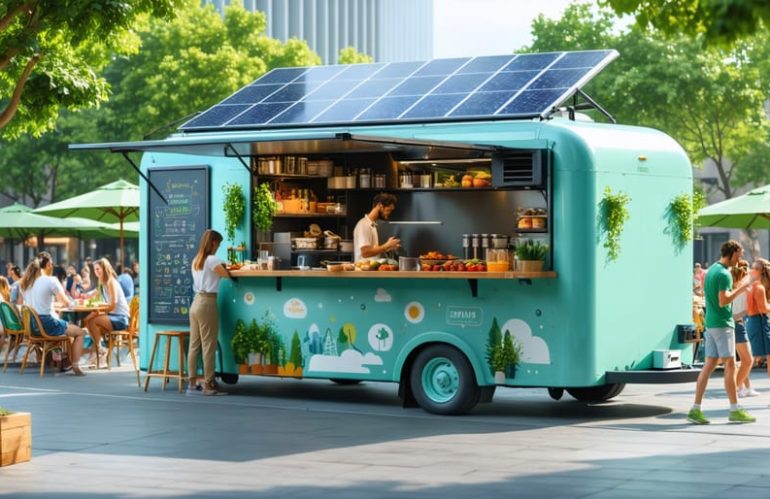
3. Sizing Your Solar System: Determining Your Power Needs
Before purchasing any components, it's crucial to accurately assess your power requirements. This involves calculating the total wattage consumed by all the electrical appliances and equipment in your food truck.
- List all appliances and equipment: Include refrigerators, freezers, ovens, microwaves, lights, point-of-sale systems, coffee makers, and any other electrical devices.
- Determine the wattage of each device: Check the appliance's label or owner's manual for the wattage rating.
- Estimate the daily usage of each device: Calculate how many hours per day each device will be in use.
- Calculate the daily energy consumption of each device: Multiply the wattage of each device by its daily usage in hours.
- Add up the daily energy consumption of all devices: This will give you the total daily energy consumption in watt-hours (Wh).
- Factor in safety margins: Add a safety margin of 20-30% to account for potential increases in power consumption or unforeseen energy needs.
- Calculate the required battery capacity: Divide the total daily energy consumption (including the safety margin) by the battery voltage (typically 12V or 24V) to determine the required battery capacity in amp-hours (Ah).
- Determine the required solar panel wattage: Divide the total daily energy consumption (including the safety margin) by the average number of peak sun hours per day in your operating location. This will give you the required solar panel wattage.
Example:
Let's say your food truck has the following electrical appliances:
- Refrigerator (150W, 24 hours/day): 150W x 24 hours = 3600 Wh
- Microwave (1000W, 0.5 hours/day): 1000W x 0.5 hours = 500 Wh
- Lights (50W, 6 hours/day): 50W x 6 hours = 300 Wh
- Point-of-Sale System (30W, 8 hours/day): 30W x 8 hours = 240 Wh
Total daily energy consumption: 3600 + 500 + 300 + 240 = 4640 Wh
Adding a 20% safety margin: 4640 Wh x 1.2 = 5568 Wh
Assuming a 12V battery system: 5568 Wh / 12V = 464 Ah battery capacity
Assuming an average of 5 peak sun hours per day: 5568 Wh / 5 hours = 1113.6W solar panel wattage
Therefore, you would need approximately 1114 watts of solar panels and a 464 Ah battery bank.
4. Choosing the Right Solar Panels and Components
Selecting the right solar panels and components is crucial for maximizing the efficiency and reliability of your solar system.
- Solar Panel Type:
- Monocrystalline: These are the most efficient and expensive type of solar panel. They are ideal for situations where space is limited.
- Polycrystalline: These are less efficient than monocrystalline panels but are also more affordable.
- Thin-Film: These are the least efficient and most flexible type of solar panel. They are often used in portable applications. For food trucks, monocrystalline or polycrystalline panels are typically the best choice due to their efficiency and durability.
- Charge Controller Type:
- PWM (Pulse Width Modulation): These are less expensive but less efficient than MPPT charge controllers.
- MPPT (Maximum Power Point Tracking): These are more expensive but more efficient, allowing you to extract the maximum power from your solar panels. MPPT charge controllers are generally recommended for food trucks due to their higher efficiency.
- Battery Type:
- AGM (Absorbent Glass Mat): These are maintenance-free, spill-proof, and have a long lifespan.
- GEL: These are similar to AGM batteries but are even more durable and can withstand deeper discharges.
- Lithium-ion: These are the most expensive but also the most efficient and lightweight battery option. They offer a longer lifespan and can be discharged to a greater depth than AGM or GEL batteries. Lithium-ion batteries are becoming increasingly popular for food trucks due to their superior performance.
- Inverter Type:
- Pure Sine Wave: These inverters produce a clean and stable AC power that is suitable for sensitive electronic devices.
- Modified Sine Wave: These inverters are less expensive but can damage some electronic devices. A pure sine wave inverter is recommended for food trucks to ensure compatibility with all appliances and equipment.
5. Installation Considerations: Mounting, Wiring, and Safety
Proper installation is essential for ensuring the safety and performance of your solar panel system.
- Mounting: The solar panels should be securely mounted to the roof of your food truck using appropriate mounting hardware. Consider the angle and orientation of the panels to maximize sunlight exposure.
- Wiring: Use high-quality, appropriately sized wiring to connect the solar panels, charge controller, batteries, and inverter. Ensure all connections are secure and properly insulated.
- Safety: Install fuses and circuit breakers to protect the system from overloads and short circuits. Use appropriate grounding techniques to prevent electrical shocks.
- Professional Installation: If you are not comfortable working with electricity, it is recommended to hire a qualified solar installer to install your system.
6. Potential Challenges and Solutions
While solar panels offer numerous benefits, there are also some potential challenges to consider:
- Initial Cost: The upfront cost of a solar panel system can be significant.
- Solution: Explore financing options, tax incentives, and rebates to reduce the initial cost.
- Space Limitations: The roof of a food truck may have limited space for solar panels.
- Solution: Choose high-efficiency solar panels and optimize the panel layout to maximize power generation.
- Weight Restrictions: The weight of the solar panels and batteries can add to the overall weight of the food truck.
- Solution: Choose lightweight solar panels and batteries, and ensure that the food truck's suspension system is adequate to handle the added weight.
- Weather Conditions: Solar panel output can be affected by cloudy weather or shading.
- Solution: Oversize the solar panel array to compensate for reduced output during less-than-ideal weather conditions.
- Maintenance: Solar panels require occasional cleaning to remove dirt and debris.
- Solution: Regularly clean the solar panels to maintain their efficiency.
7. Table Price of Solar Panels for Food Truck
| Component | Description | Approximate Price Range |
|---|---|---|
| Solar Panels (300W) | Monocrystalline, High Efficiency | $200 - $350 per panel |
| Charge Controller | MPPT, 30A-40A | $150 - $300 |
| Batteries (100Ah) | Deep Cycle AGM or Lithium-Ion | $200 - $400 per battery |
| Inverter (2000W) | Pure Sine Wave | $200 - $500 |
| Mounting Hardware | Roof Mount Kit, Weatherproof | $50 - $150 |
| Wiring & Connectors | Heavy Gauge, UV Resistant | $50 - $100 |
| Fuses & Breakers | Overcurrent Protection | $20 - $50 |
| Installation Labor | Professional Installation (Optional) | $500 - $1500 |
| Total System Cost | Estimates Vary Depending on System Size & Components | $1500 - $5000+ |
8. Frequently Asked Questions (FAQ)
-
How long will solar panels last on a food truck?
High-quality solar panels are designed to last for 25 years or more.
-
How much does it cost to install solar panels on a food truck?
The cost can vary depending on the size of the system, the type of components used, and whether you hire a professional installer. Expect to pay between $1500 and $5000 or more.
-
Can I power my entire food truck with solar panels?
Yes, if you properly size the system to meet your power requirements.
-
Do I need to clean my solar panels?
Yes, regular cleaning will help to maintain their efficiency.
-
What happens if it's cloudy?
Solar panel output will be reduced on cloudy days. You may need to rely on your batteries to provide power.
-
Is it legal to operate a food truck with solar panels?
Yes, as long as you comply with all local regulations and codes.
Conclusion
Investing in solar panels for your food truck is a smart and sustainable decision that can offer numerous benefits, from reduced operating costs and environmental friendliness to increased independence and enhanced brand image. While the initial investment may seem daunting, the long-term savings and advantages make solar power a worthwhile consideration for any food truck entrepreneur. By carefully assessing your power needs, choosing the right components, and ensuring proper installation, you can harness the sun's energy and power your culinary dreams for years to come. Embrace the future of mobile food service – go solar!